JOIN US
Join our community!
Sign up to our newsletter to hear about the latest
special offers and news, exciting projects and events.
Welcome to the world of Beaumier.


{{responseMessage}}
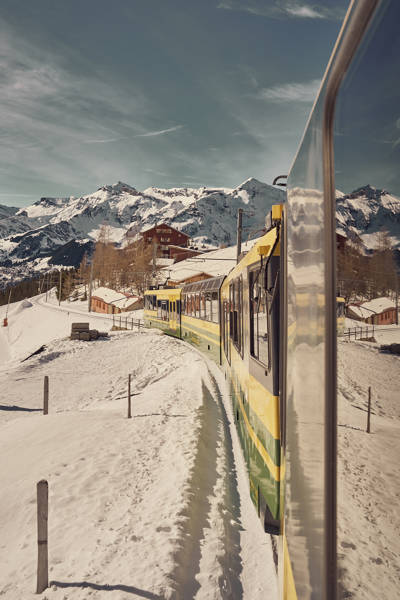
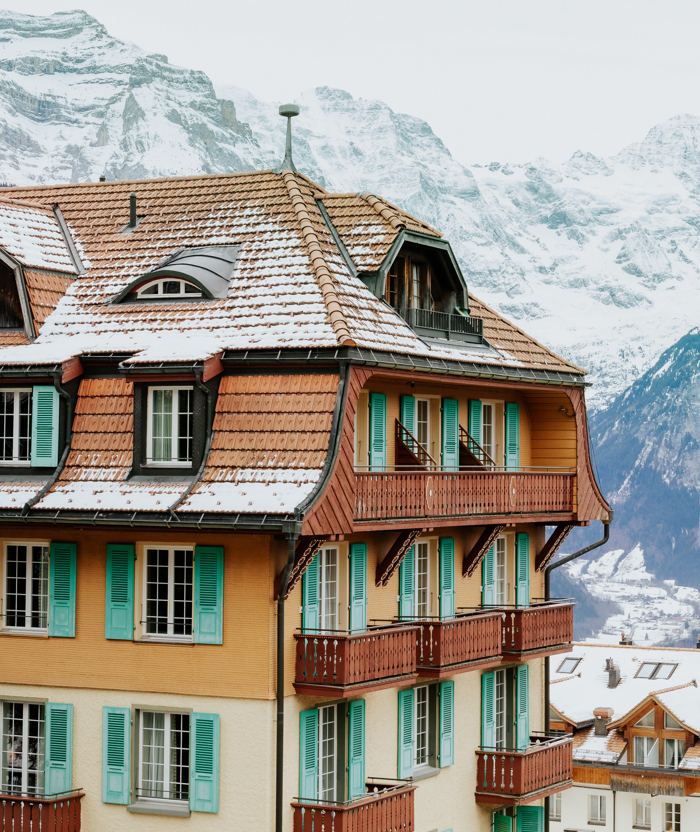
The train slows, the doors open, and the air changes first. There is no horn, no idling engine, no low hum of traffic waiting to fill the silence — only snow settling on a rooftop, boots on packed stone, and somewhere above, a bird testing the quiet. Wengen has been car-free for as long as anyone can remember, not as a rule imposed on the village but as something closer to its nature. There is a particular kind of relief in realising, a few minutes after arriving, that you have stopped listening for traffic altogether. From the moment you step off the train, everything slows to match it.
Luggage here travels on small carts, wheeled by hand along streets built for walking rather than driving. Skis rest over shoulders on the way to the lift. A pram moves easily down the middle of the road, because there is nothing coming the other way. None of this feels like an inconvenience — it feels like the way a village is supposed to work, before cars decided otherwise.
Without traffic to dodge, the pace of exploring changes too. You wander rather than navigate. A shopfront, a church bell, the sound of skis being unclipped somewhere nearby — each becomes something to notice rather than something to get past. Arriving in Wengen isn't a matter of parking and unpacking. It's closer to simply stepping into the day, fully, with nothing between you and it.
The approach is part of the experience, not a means to it. Switzerland's rail network makes it possible to leave the car behind from almost anywhere in the country, with the route narrowing, city by city, into a single valley.
From Zurich, direct trains run to Interlaken Ost in around two hours, cutting across the lowlands before the mountains begin to close in. From Basel, the journey is similar in length, also on a direct connection to Interlaken Ost, with the Jura giving way to greener, steeper country as the train heads south. From Geneva, there's no direct line — the journey involves a change in Bern, and takes closer to three hours in total — but the wait on the platform there is short, and the second half of the trip, once the train turns toward the Bernese Oberland, tends to make up for the extra change.
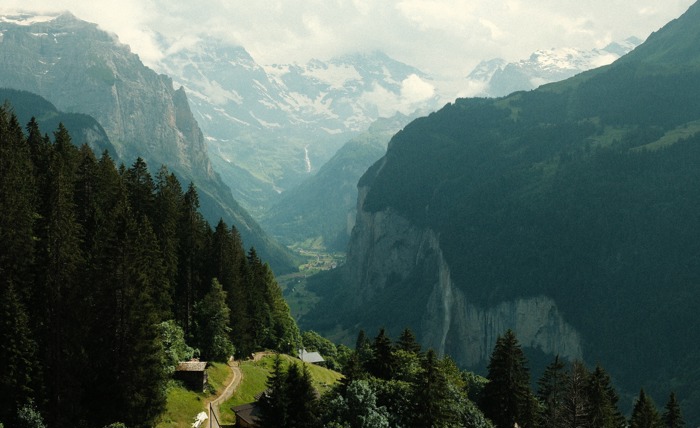
Whichever city you start from, the final approach is the same: from Interlaken Ost, a smaller train climbs to Lauterbrunnen in about twenty minutes, and from there, the last leg into Wengen takes a cogwheel train up the cliffside in around thirteen more, the view opening in stages the higher it climbs. There is no faster route, and no reason to want one.
Once the train reaches the village, the last stretch is entirely on foot — or by sledge, in winter, if luggage or legs prefer it. Most of Wengen's hotels, including the Grand Hotel Belvedere, sit close enough to the station that the walk barely registers as one. The Getting Here page lays out the full journey by train and cable car from each of these starting points, but the short version is this: arriving without a car isn't a compromise here. It's the point.
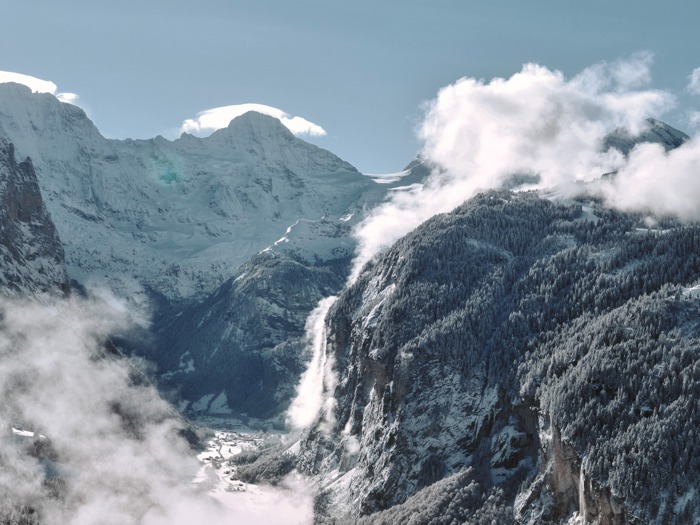
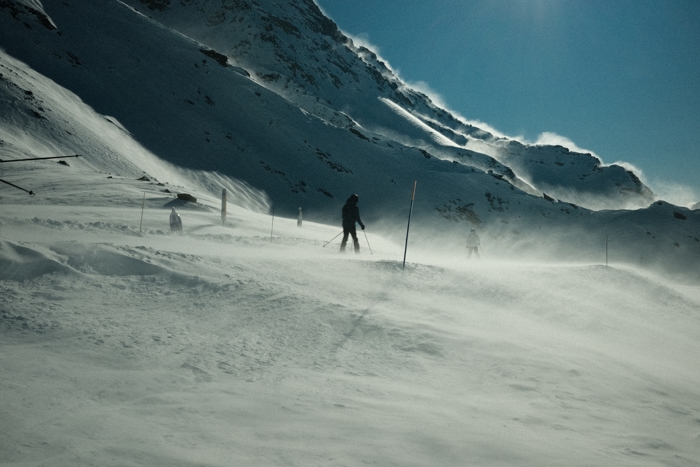
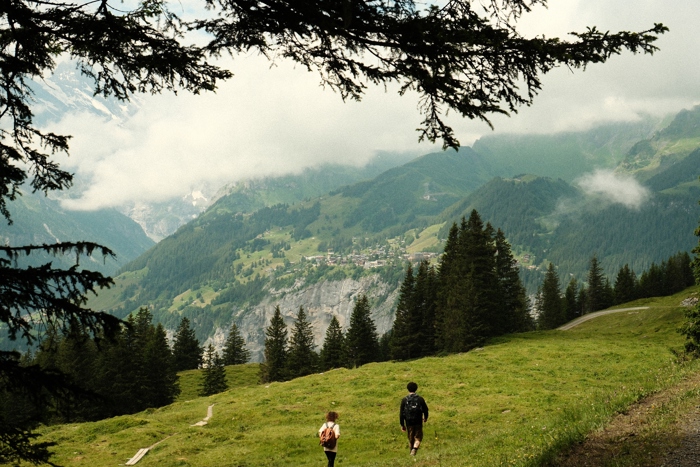
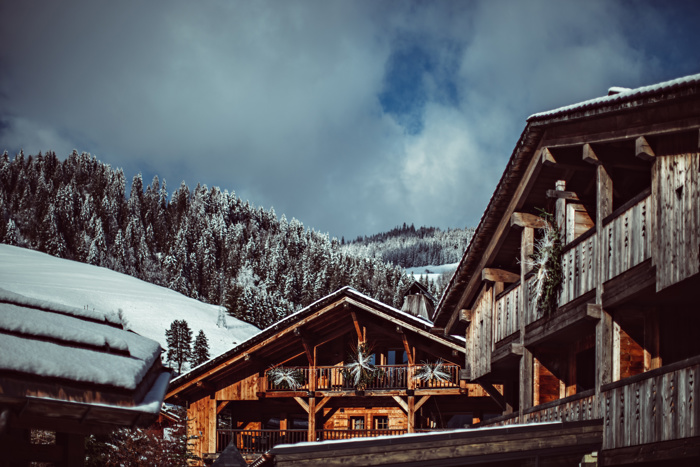
Take the traffic away and the mountains get louder — not literally, but in every way that matters. Wind moves through pine trees without competition. Footsteps on packed snow carry further than expected. A distant avalanche, or just the creak of a chalet settling in the cold, becomes audible in a way it never would be over engine noise.
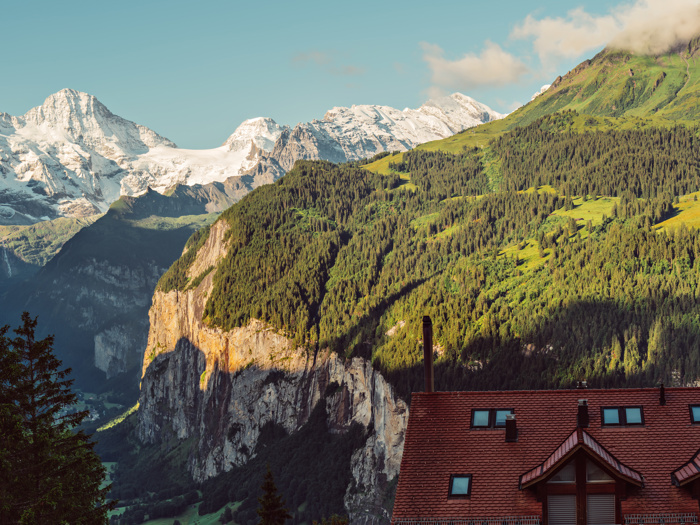
Stress has a way of dissolving here that has less to do with the scenery and more to do with the absence of everything that usually demands attention: no traffic to check for, no horn to brace against, no need to hurry across a road. Walking stops being a means of getting somewhere and becomes, quietly, the point of being there at all. There are other car-free villages in the Alps, but few sit this openly at altitude, with the Jungfrau, Mönch, and Eiger visible from nearly every street.
Days spent walking tend to end the same way: hungry, unhurried, ready for something warm. For those who want to fill the hours between arrival and dinner, our 5-day itinerary in the Jungfrau Valley lists the hikes, scenic walks, and sleigh rides that make up most of a Wengen day, none of them requiring anything more than good boots.
By train, roughly two and a half hours from Zurich or Basel, both with a direct connection to Interlaken Ost, and closer to three hours from Geneva, which requires a change in Bern. All three routes finish the same way, via Lauterbrunnen and the cogwheel train up to Wengen.
Yes. Private cars are not permitted in the village; residents and guests get around on foot, by train, or by small electric vehicles used mainly for deliveries.
By train from Lauterbrunnen, which is itself reached by train from Interlaken. Cars can be left in a car park in Lauterbrunnen for the duration of the stay.
Yes. The absence of traffic makes the village easy to move through with a pram, and most hotels, including the Grand Hotel Belvedere, are close to the station.
Yes. Small carts and, in winter, sledges are used throughout the village to move luggage between the station and hotels.
This site is protected by reCAPTCHA.